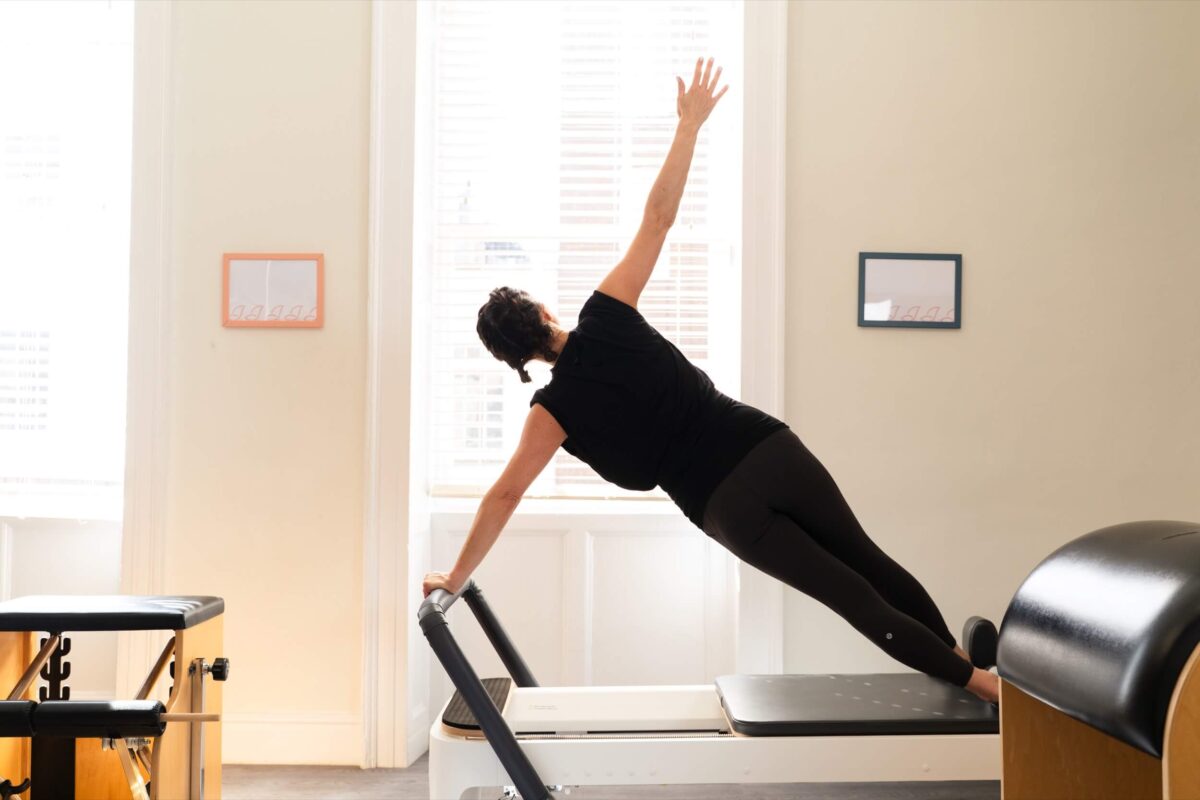

Yes! Pilates can absolutely help reduce persistent back pain when it’s taught by experienced instructors who tailor it to how you move.
What you need to know:
- Research shows that Pilates can help reduce back pain by improving movement, strength and control, leading to lower pain levels, better physical function and reduced disability compared with minimal intervention.
- Private sessions are usually recommended to start, so the programme can be tailored to you.
- Pilates Equipment that will be used to help you: Reformer, Cadillac, Wunda Chair, Ladder Barrel and Spine Corrector. Soul Pilates is the only Pilates studio in Bristol to have all Pilates Equipments available since 2015.
Continue reading to find out more…
When pain won’t go away
Back pain affects millions of people every year and, for many, it becomes something they simply learn to live with.
The good news is that there’s now a growing body of research showing that Pilates can be an effective way to help reduce persistent low back pain, improve movement and build confidence in your body again.
But here’s something that’s equally important.
Not all Pilates is taught in the same way.
At Soul Pilates, helping people move out of pain has been at the heart of what we do since we opened our very first studio in 2015.
Why Soul Pilates is different
When we opened our first studio, we weren’t based on the high street. We were based inside a busy osteopathic practice.
That meant we spent years working closely alongside osteopaths, seeing clients transition from treatment into movement. We learnt first hand that while hands on therapy can be incredibly valuable, long term change happens when people learn to move differently.
Over the last decade we’ve worked with thousands of people experiencing back pain, neck pain, hip pain and other musculoskeletal problems. That experience has shaped the way we teach today.
Rather than simply taking people through exercises, our focus is on helping your body move more intelligently.
Why does back pain happen?
There are many different causes of back pain, which is why it’s always important to seek appropriate medical advice if your pain is severe, unexplained or accompanied by other concerning symptoms.
However, one thing we see time and time again is that people aren’t necessarily weak. They’re simply inefficient.
Our bodies are incredibly good at finding the easiest way to complete a movement. Over time we begin to rely on the same muscles, the same joints and the same parts of our spine over and over again.
Those areas gradually become overloaded.
Meanwhile, other parts of the body contribute less and less.
It’s a little like asking two members of a team to do all the work while everyone else stands back. Eventually those two people burn out.
The body works in much the same way.
A spine that shares the work
One of the biggest things we look at is how your spine moves.
Your spine is designed to distribute movement across many different joints. Yet when someone has back pain, we often find that they’re only moving through a handful of segments while the rest of the spine has become stiff or underused.
Those few mobile segments end up working far harder than they were ever designed to.
The result? More compression. More strain. More irritation.
At Soul Pilates, we gently encourage movement throughout the whole spine, helping each segment contribute a more effectively.
When movement is shared more evenly, the overloaded areas no longer have to do all the work. The body becomes more efficient and many people begin to notice that everyday movements feel easier and more comfortable.
Pilates isn’t about working harder
One of the biggest misconceptions about Pilates is that it’s simply about strengthening your core.
Strength matters, but strength without efficiency often just reinforces poor movement patterns.
Our philosophy has always been different. We believe the body becomes stronger when movement is intelligent, precise and efficient. So instead of asking your body to work harder, we teach it to work better.
That means improving coordination, control and balance so that your muscles work together as a team rather than competing against each other. When the body moves well, unnecessary tension reduces and everyday activities often become much easier.
What the research says around back pain & Pilates
Research over the last two decades suggests Pilates is an effective option for many people with persistent low back pain. Multiple studies have shown that it can help improve pain levels and physical function.
Clinical guidelines for managing persistent low back pain also increasingly recommend exercise and movement as part of long term care, with Pilates being one evidence based option.
Of course, Pilates isn’t a magic fix.
The best results come from an individualised programme that’s appropriate for your symptoms, taught by experienced instructors who understand movement and can adapt exercises to your needs.
How to get started
If you’re experiencing back pain, we recommend starting with a few private sessions.
That’s because no two people experience back pain for the same reason.
A private session allows us to understand how your body moves, identify where you’re compensating and create a programme that’s tailored to you.
In a 1:1 session, you’ll have access to the full Pilates studio, not just the Reformer. Using equipment such as the Cadillac, Wunda Chair, Ladder Barrel and Spine Corrector allows us to support or challenge the body in different ways, making movements more accessible than they would be on a mat alone.
Then, as their knowledge and confidence grows, many of our clients choose to progress into our small group classes.
As always, if you have any questions, don’t hesitate to reach out to us at hello@soulpilates.co.uk.
See you in the Studio!